Activity
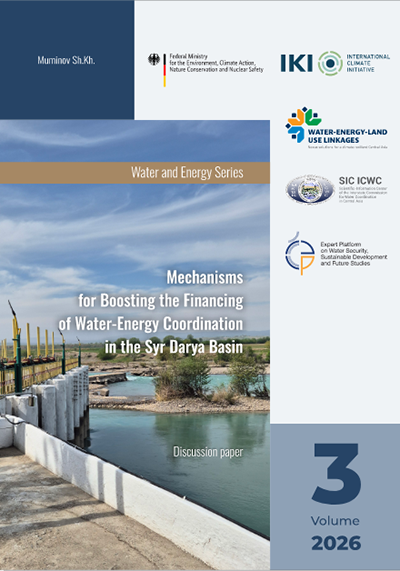
Research: Mechanisms for boosting the financing of water-energy coordination in the Syr Darya basin
Author: Muminov Sh.
Contributing experts: Ziganshina D.R., Shamsiev Kh.A., Sorokin A.G., Zhailoobaev A.Sh., Pulatov Ya.E., Umarov D., Kholikzoda M., Juraev Yo.A., Mustafoev K.M., Mukhiddinov F.Kh., Namozov O.Sh.
Water–energy coordination in the Syr Darya River Basin is built on a longstanding seasonal interdependence: upstream countries store water and generate hydropower, while downstream countries rely on that water during the growing season. Since the collapse of the Soviet-era unified grid and economic system, Kazakhstan, Kyrgyzstan, Tajikistan, and Uzbekistan have managed this balance largely through annual bilateral and multilateral protocols between their water and energy agencies, alongside regional coordination bodies (ICWC, BWO Syr Darya, and CDC “Energia”).
The report’s central finding is that technical and operational cooperation has outpaced its financial and economic underpinnings. While existing protocols allow countries to coordinate annual operation regimes, they lack durable settlement mechanisms, transparent methodologies for determining exchange equivalents, independent compliance monitoring, and payment enforcement tools. As a result, investors view cross-border water and energy projects as high-risk, infrastructure funding remains heavily reliant on national budgets, and long-term planning is constrained. Moving forward, basin-wide coordination needs to evolve from short-term operational agreements on water releases and power deliveries into a comprehensive financial and economic framework.
To address this gap, the report reviews financing models suited to the basin (blended, program-based, results-based, project, carbon finance, PPPs and dedicated regional funds) and specific instruments (concessional loans from IFIs, grants, Eurobonds, green bonds, sukuk, and endowment funds), paired with guarantees and insurance mechanisms to mitigate investment risk. Drawing on international best practices and regional case studies—including the Qoirakkum and Rogun hydropower projects and the CASA-1000—the report outlines three complementary financing models.
This report was prepared as part of the German Federal Foreign Office’s International Climate Initiative (IKI) project “Regional mechanisms for the low-carbon, climate-resilient transformation of the energy-water-land Nexus in Central Asia.” The project supports the Syr Darya Basin countries in identifying and implementing mutually beneficial water and energy solutions.