
Section 2. Water management situation in the Aral Sea basin
2.1. Water-Management Situation in the Amu Darya and Syr Darya River Basins
Water Resources
In 2024, the total annual runoff in the Amu Darya and Syr Darya river basins amounted to 108.24 km3.
Amu Darya River Basin
The total annual runoff of rivers within the smaller Amu Darya basin (the Amu Darya tributaries: Vakhsh, Panj, Kafirnigan, and Surkhandarya) amounted to 66.25 km3, including 56.4 km3 of natural (unregulated) flow of the Amu Darya at the “Nominal Kerki” gauging section located upstream of intake to the Garagumderya Canal. The Amu Darya flow at the “Nomimal Kerki” totaled 5.05 km3 in the first quarter, 43.28 km3 during the growing season, and 8.07 km3 in October–December.
As of January 1, 2024, the combined water storage in the Nurek and Tuyamuyun reservoirs amounted to 13.26 km3.
Syr Darya River Basin
For the Syr Darya River basin, the total annual runoff, including the Naryn, Karadarya, and Chirchik rivers, as well as smaller rivers, amounted to 41.99 km3, of which 24.22 km3 was the total inflow to three reservoirs, such as Toktogul, Andijan, and Charvak.
By January 1, 2024, the total storage of reservoirs within the basin was 17.55 km3, including 12.28 km3 in the major reservoirs of the flow formation zone (Toktogul, Andijan, and Charvak reservoirs).
Operation of Reservoir Hydrosystems
The annual inflow to the Nurek Reservoir from the Vakhsh River amounted to 20.67 km3, including 16.4 km3 during the growing season, which corresponds to 79% of the annual inflow. Annual water releases from the reservoir totaled 20.5 km3, including 12.63 km3 during the growing season.
The annual inflow to the Tuyamuyun Hydrosystem amounted to 21.95 km3, exceeding the forecast by 1.77 km3; inflow during the growing season totaled 15.86 km3. Annual water releases from the reservoir reached 21.12 km3, fitting the BWO Amu Darya’s schedule, including 14.83 km3 during the growing season or 104% of the schedule.
The annual inflow to the Toktogul Reservoir from the Naryn River amounted to 14.2 km3, including 10.7 km3 during the growing season, or 75% of the annual inflow. Annual water releases from the reservoir totaled 13.45 km3, including 4.99 km3 during the growing season, which represents 37% of the annual water releases. The Toktogul Reservoir was filled by 0.76 km3, and its storage reached 11.19 km3 by the end of the year.
Water Allocation and Water Shortage
The allocation of water resources in the Amu Darya and Syr Darya river basins among the Central Asian countries is carried out by the ICWC on the basis of limits/quotas established for the hydrological year (October–September). Below we show an analysis of water allocation on a calendar-year basis (January–December).
Amu Darya River Basin
In 2024, water abstraction from the Amu Darya River basin, against an established withdrawal limit of 55.65 km3, amounted to 47.99 km3, including 33.83 km3 during the growing season. The annual limit was utilized by 86%, and by 85% during the growing season. By country, water abstraction was distributed as follows:
• Tajikistan — with a limit of 9.93 km3, actual abstraction amounted to 8.88 km3;
• Turkmenistan — with a limit of 22.14 km3, actual abstraction amounted to 19.97 km3;
• Uzbekistan — with a limit of 23.58 km3, actual abstraction amounted to 19.14 km3.
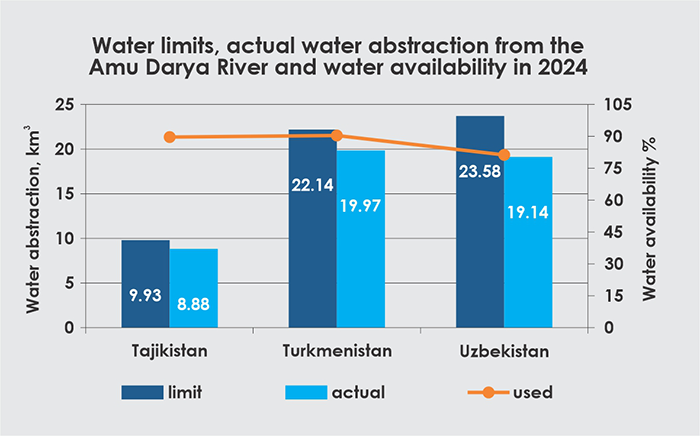
In the reach from the Nurek HPP to the Tuyamuyun Reservoir (Darganata gauging station), the water shortage amounted to 9% for Tajikistan, 2% for Turkmenistan, and 10% for Uzbekistan during the growing season. In the reach from the Darganata gauging station to the Samanbay gauging station, Turkmenistan and Uzbekistan received 26% and 29% less water, respectively, during the growing season than the required amount (limit).
Syr Darya River Basin
The total water abstraction from the Syr Darya River basin (up to the inflow to the Shardara Reservoir) amounted to 13.44 km3, including 9.85 km3 during the growing season, which corresponds to 83% of the canal withdrawal limit. Discharge from the Syr Darya River to the Arnasay Lake System totaled 704 million m3 (500 million m3 in 2023).
The BWO Syr Darya’s plan for water abstraction from the Syr Darya River was fulfilled by 83%. In the reach from the Toktogul to the Shardara reservoirs, the water shortage amounted to 31% for Tajikistan, 10% for Kyrgyzstan, and 21% and 14% for Kazakhstan and Uzbekistan, respectively, during the growing season.
Inflow to the Aral Sea Region
According to the Committee for Regulation, Protection and Use of Water Resources of the Kazakhstan’s Ministry of Water Resources and Irrigation, the inflow into the Northern Aral Sea from the Syr Darya amounted to 2.6 km³ in 2024.
1.22 km3 of water was delivered to the South Aral region from the Amu Darya River (Samanbay gauging station); the total inflow, including river runoff, collector–drainage water, and canal discharges, amounted to 2.59 km3.
Based on research by SIC ICWC, the South Aral region shall receive 8 km³ of water from the Amu Darya River in wet years and 3.5 km³ in dry years. However actually, in 2024, 2.59 km³ of water was delivered to the South Aral region.
Meeting Water Demands
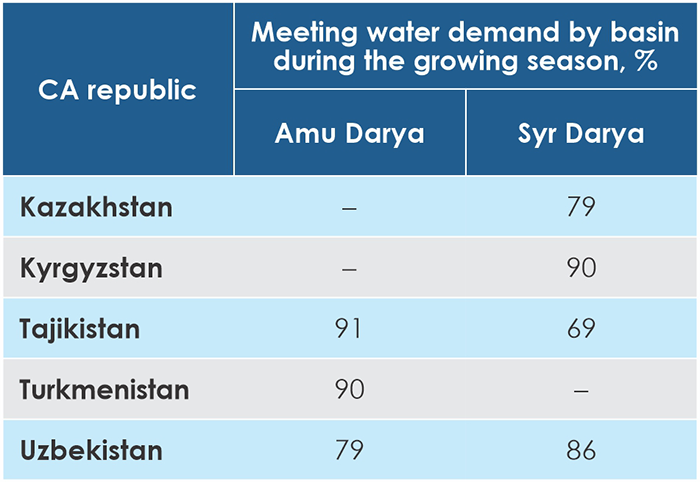
The Table below illustrates how water demands were met for the Central Asian states during the growing season.
2.2. Large Aral Sea and the Amu Darya Delta
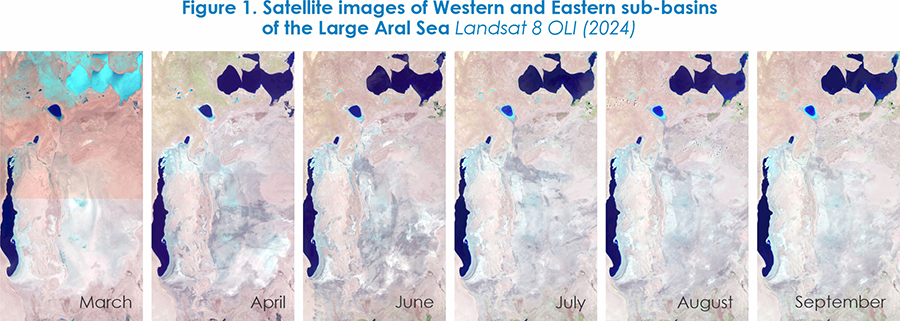
This section was prepared using data of the BWO Amu Darya, the Aral Sea Region Delta Authority, and the Uzbek Hydrometeorological Service (UzHydromet). The RS-based data (Landsat 8 OLI images) on the Eastern and Western sub-basins of the Large Aral Sea (LAS) and the lake systems of the Amu Darya River delta (http://cawater-info.net/aral/data/monitoring_amu.htm) was also used. In the satellite imagery analysis, we utilized NDVI with the refined threshold values to identify three surface categories: (1) open water surface, (2) wetland, and (3) dryland. The satellite images of the Aral Sea are shown in Figure 1.
2.2.1. Water Supply to the Amu Darya Delta and the Large Aral Sea
Water Supply to the Amu Darya Delta
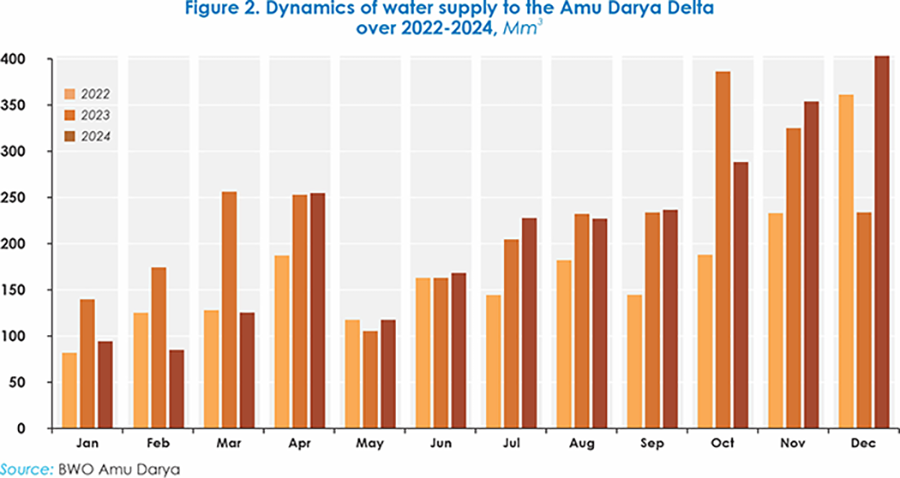
According to BWO Amu Darya, in 2024, 2,588 Mm³ of water (including river runoff and water discharged from canals
and collecting drains) reached the Amu Darya Delta. This is 122 Mm³ less than in 2023 but 533 Mm3 more than in 2022. The monthly dynamics of water supply to the Amu Darya delta over 2022-2024 is shown in Figure 2.
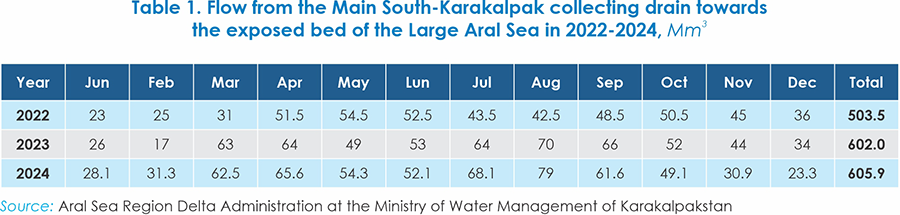
Flow from the Main South-Karakalpak collecting drain towards the exposed bed of the Large Aral Sea
Bypassing the Amu Darya Delta, 605.9 Mm³ of collector-drainage water flowed towards the exposed bed of the Large Aral Sea from the Main South-Karakalpak (Right-bank) collecting drain (Table 1). This is 102.4 Mm³ and 3.9 Mm3 more than in 2022 and 2023, respectively.
Total inflow into the Large Aral Sea
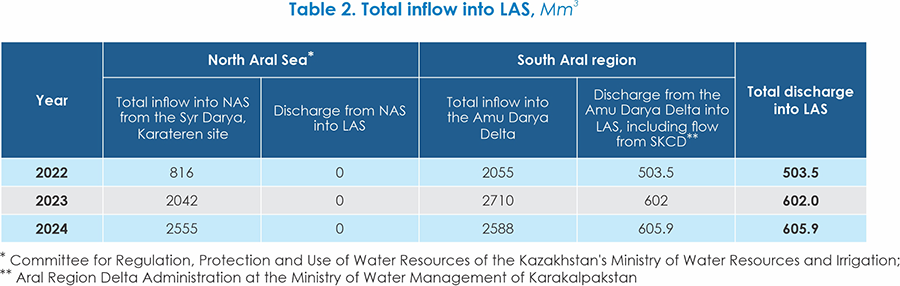
In 2024, water flowed to the Large Aral Sea (LAS) only from the Main South-Karakalpak collecting drain (SKCD) - 605.9 Mm³. The LAS has not got water from the Amu Darya River Delta and the Northern Aral Sea (NAS) (Table 2).
2.2.2. Open Water Surface and Wetland Areas in Eastern and Western Sub-basins of the Large Aral Sea
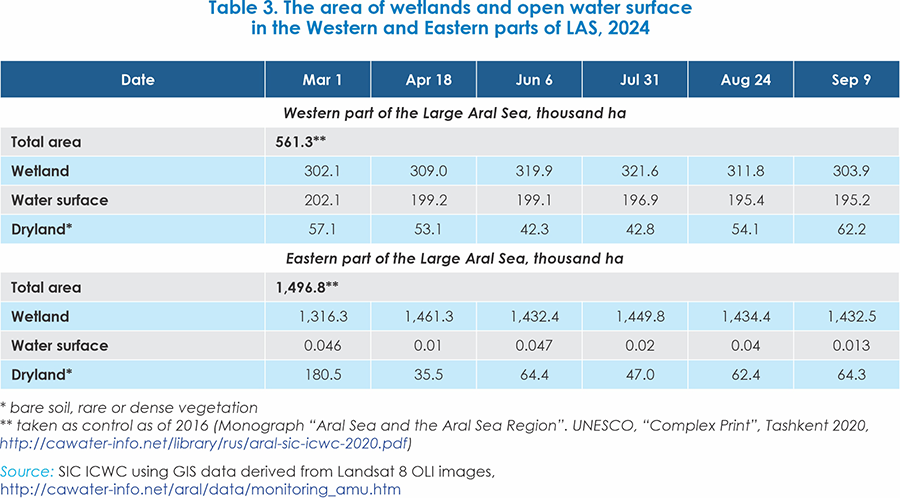
Based on the results of processing of satellite images for January to September 2024, the area of open water surface decreased from 202.1 to 195.2 thousand ha in Western sub-basin of LAS and from 0.046 to 0.013 thousand ha in Eastern sub-basin of LAS (Table 3).
2.2.3. Lake Systems in the Amu Darya Delta
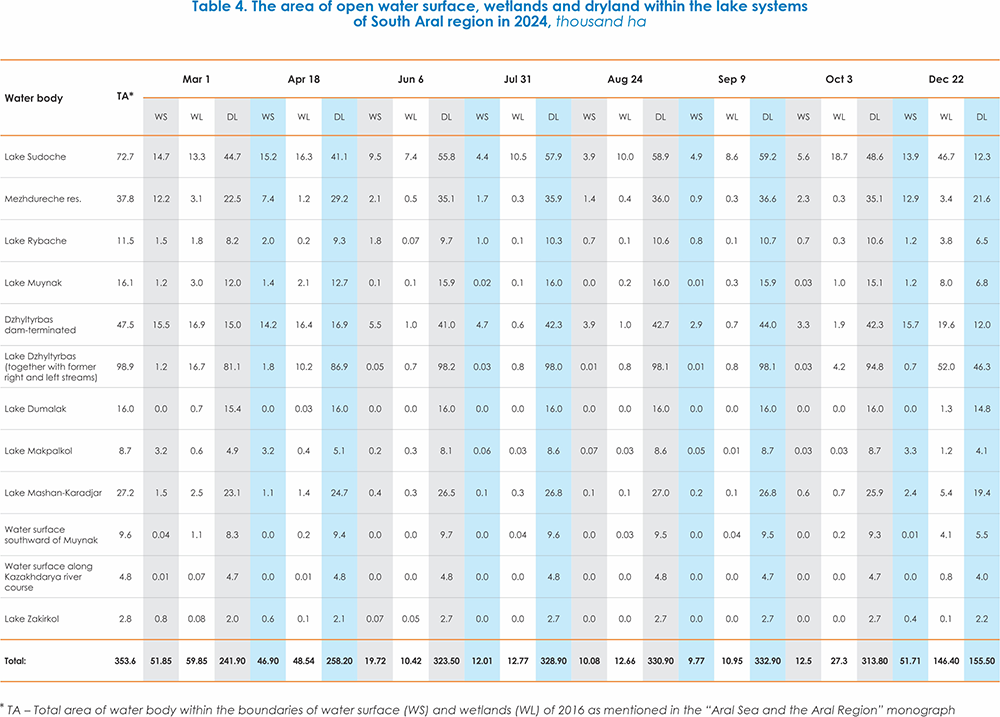
Lake systems in the Amu Darya delta are represented by small local water bodies of the South Aral region. Since March to December 2024, the open water surface area of the lake systems remained virtually unchanged: 51.8 to 51.7 thousand ha (Table 4). A water supply of 2,588 Mm³ to the Amu Darya delta is not enough for fisheries or for sustaining the ecosystems of Lakes Sudoche, Rybache, Muynak, and Dzhyltyrbas.
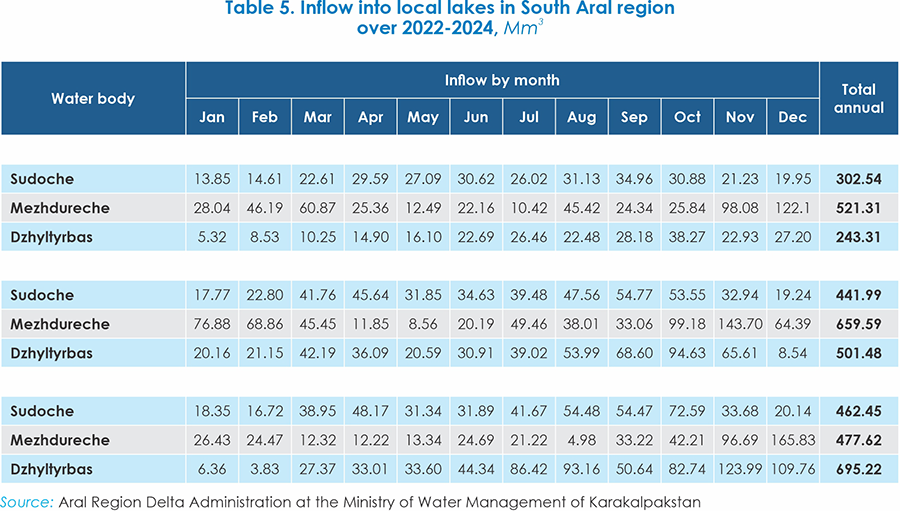
In 2024, the inflow of collector–drainage water into local water bodies of the South Aral region (Table 5) increased compared to 2022, rising from 1,067.16 to 1,635.29 Mm³. This increase is associated with higher water deliveries to the Amu Darya delta during the growing season (Figure 2).
Conclusion
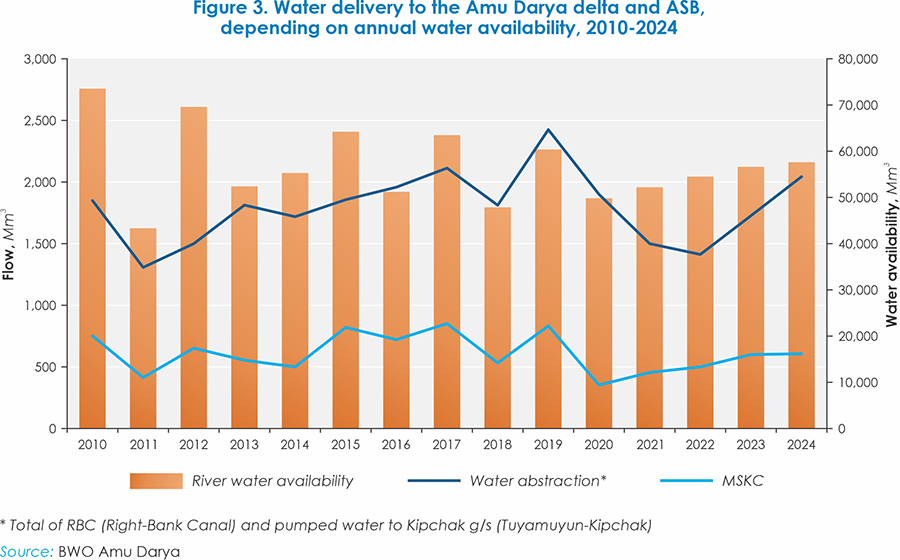
Despite lower quantity of water supplied to the Amu Darya delta compared to 2023, discharges from the Main South-Karakalpak collecting drain (SKCD) toward the Aral Sea Basin slightly increased in 2024. This is related to annual flow conditions and, particularly, depends on the regulation of river flow at the Tuyamuyun Reservoir (Figure 3). Since the beginning of 2024, the water surface area of both the eastern and western parts of Aral Sea have decreased. Small local water bodies in the South Aral region continue facing challenges with water supply.
Development and support
Scientific-Information Center ICWC