
Section 15. Global Risks 2025
This Section presents key global risks and foreign policy trends according to the versions of several analytical centers, namely the analysts of the World Economic Forum (WEF), the consulting company Eurasia Group, UN, and the Stimson Center think tank.
15.1. Risks 2025 (WEF version)
The 20th edition of the Global Risks Report 2025 warns of an increasingly fragmented world, where escalating geopolitical, environmental, social, and technological risks threaten global stability and progress. The report details global risk perceptions in 2024-2025 across three timeframes: near-term (2025), short- to medium-term (to 2027), and long-term (to 2035).
Declining optimism. In 2025, the global situation will be characterized by increasing conflicts, more frequent extreme weather events, societal polarization, and the accelerated spread of misinformation. A majority of respondents (52%) anticipate an unsettled global outlook next two years, while another 31% expect turbulence. Over the 10-year timeframe, 62% of respondents expecting stormy or turbulent times. Trust in existing governance remains low.
Growing geopolitical and geoeconomic confrontation. State-based armed conflict was selected as the top risk in short-term. This reflects growing concerns about conflicts (Ukraine, Middle East, Sudan). Geo-economic confrontation is now perceived as a more significant risk (climbing from 14th to 9th place), alongside persistent leading threats like cyber espionage and warfare.
Disinformation – main risk in the short-term. For the second consecutive year, misinformation and disinformation top the global risk forecast. It affects elections, distorts perceptions of conflict and undermines trust in goods and countries.
A growing sense of societal fragmentation. Societal fractures are central to the overall risks landscape. Inequality is perceived as the most central risk of all, playing a significant role in both triggering and being influenced by other risks. Societal polarization, involuntary migration or displacement and erosion of human rights and/ or civic freedoms also feature in the top. Despite receding economic risks, the impacts of the cost-of-living crisis since 2022 contributed to inequality. Economic downturn, inflation, and debt were selected among the top causes of inequality.
Environmental risks – from long-term concern to urgent reality. The impacts of environmental risks have worsened in intensity and frequency since the Report was launched in 2006. The outlook for environmental risks over the next decade is alarming – while all 33 risks are expected to worsen in the short and long term, environmental risks present the most significant deterioration. Extreme weather events are being top ranked for the second year running. Biodiversity loss and ecosystem collapse ranks second over the 10-year horizon. The report shows generational divergence when it comes to risk perceptions related to environmental issues, with younger survey respondents (<30 years old) being more concerned about this than older age groups.
Technological risks – still “under the radar”. Concerns about adverse outcomes of AI technologies are low in the risk ranking in short-term period. However, in the 10-year time horizon, these threats become increasingly important, i.e. due to generative AI and widespread dissemination of false or misleading information. The report further identifies emerging risks in biotechnology, such as the malicious misuse of gene editing and brain-computer interfaces, categorizing them as low-probability yet high-impact threats.
A fragmenting world: the time to act is now. 64% of respondents believe that we will face a multipolar or fragmented order, in which middle and great powers contest, set and enforce regional rules and norms. The growing necessity for collective international action stands in stark contrast to the erosion of global cooperation.
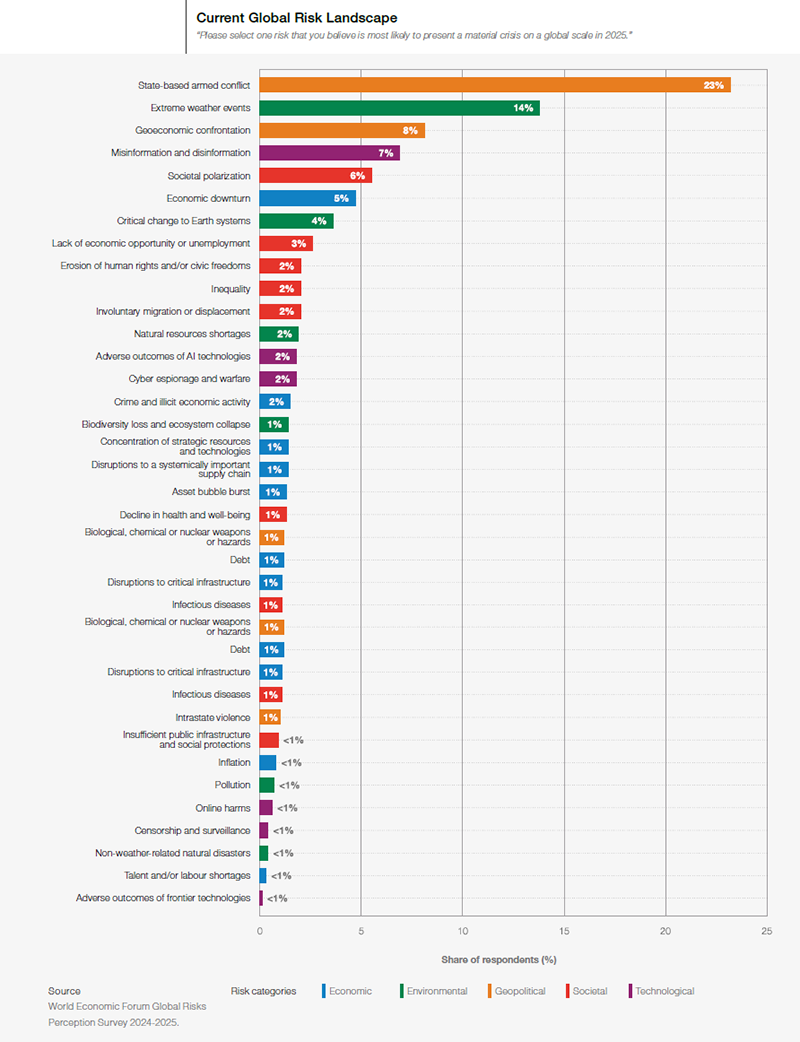
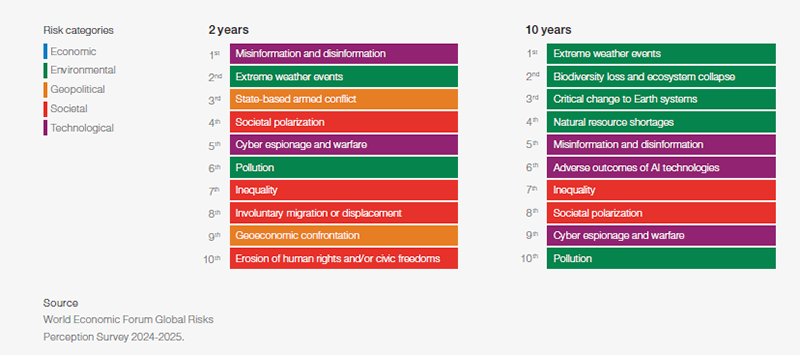
Source: Global Risks Report 2025
15.2. Risks 2025 (Eurasia Group version)
The Eurasia Group warns that the growing influence of economic elites in the U.S. is leading to an “oligarchization” comparable to the Golden Age era. A key focus is the potential role of Elon Musk if Donald Trump returns to power; the report suggests Musk could significantly shape policy on innovation, economy, and global stability. The report also links this concentration of power to rising public discontent, eroding confidence in institutions, and a heightened risk of violence. Together, these trends are increasing geopolitical instability and threatening to create a global leadership vacuum.
1. The G-Zero wins. The global leadership deficit will reach a critical level in 2025, according to the Eurasia Group. No one power or group of powers is both willing and able to drive a global agenda, which will lead to increased instability, weakening security and economy, increasing the influence of rogue countries and the risk of large-scale conflicts. International institutions – UN Security Council, the International Monetary Fund, the World Bank, and so on – no longer reflect the underlying balance of global power. The risk of a generational world crisis, even a new global war, is higher than at any point in our lifetimes.
2. Rule of Don. In a second term, Donald Trump will come to power with greater confidence, the support of a unified Republican Party and battle-hardened loyalists. Unlike in 2017, he will be more experienced and better organized in the use of administrative leverage. Trump feels that his first-term agenda was thwarted by disloyal appointees and political adversaries within the so-called “deep state”. Therefore, his priority will be a large-scale purge of the federal bureaucracy by replacing professionals with loyalists, especially in the key departments – the Justice Department and the FBI. He also aims to strengthen control over the budget by appointing dedicated officials, pressuring Congress, and potentially canceling approved spending. These actions could provoke judicial conflicts and strengthen presidential power at the expense of the legislative branch.
3. US-China breakdown. The détente established by Presidents Joe Biden and Xi Jinping in 2023 will be broken by Donald Trump's return to office. This will create an unmanageable economic gap between the two superpowers, heightening the risk of global economic shocks. The relationship will change trajectory because of trade policy. Trump will announce and implement new tariffs on Chinese goods shortly after his inauguration. The average rate of duty on Chinese imports could potentially double, reaching 50-60%, which would be unacceptable for Beijing and could increase tensions.
4. Trumponomics. President-elect Trump will inherit the strongest economy with low unemployment, stable inflation, and rising market optimism. However, his policies will undermine its strength through higher inflation and reduced growth. Trump's agenda poses underappreciated risks to the US economic outlook. Two of Trump's core campaign promises will be particularly detrimental.
5. Russia still rogue. In 2025, Russia solidifies its position as the world's leading rogue power and continues to lead the “Axis of Rogues” – its strategic military partnership with Iran and North Korea. Despite a likely ceasefire in Ukraine, Russia will take hostile, asymmetric steps against EU countries, particularly in Eastern Europe. Vladimir Putin’s policy is largely driven by a desire to revise the European security system and counter the influence of Western nations, including NATO and the US, thereby strengthening Russia’s international standing.
6. Iran on the ropes. The Middle East will remain a combustible environment in 2025, for one big reason: Iran hasn't been that weak in decades. Tehran lost key allies: Hamas was defeated, Hezbollah was nearly wiped out, and Bashar al Assad was suddenly driven from power. Its strategy of relying on proxies has run its course. Iran retains a formidable arsenal of missiles and drones. It also has its nuclear program. But any move to build a weapon would likely be quickly detected and provoke swift American and Israeli preemptive strikes. Simply put, Iran is a sitting duck.
7. Beggar thy world. Global markets are riding high on hopes of a strengthening global economic expansion in 2025. They're in for a rude awakening. The world's two largest economies – China and US – are set to export disruption to everyone else this year, short-circuiting the global recovery and accelerating geoeconomic fragmentation. China's economy is experiencing its weakest performance: collapsing confidence, mounting debt and surplus of production are forcing Beijing to expand its exports threatening global competition. On the other hand, Trump's policy mix will also strengthen the dollar and keep US interest rates higher, increasing pressure on the rest of the world when it's least equipped to handle it.
8. AI unbound. AI's power and capabilities will continue to grow in 2025, with new models able to act autonomously, create self-replicas, and further blur human-machine boundaries. But as most governments opt for lighter-touch regulation and international cooperation falters, the risks and collateral damage from unbound AI will multiply.
9. Ungoverned spaces. This risk stems from a deepening G-Zero, where the world's most powerful actors are abdicating global leadership. As U.S. leadership wanes and international cooperation frays, conflict zones are expanding into new domains like airspace and cyberspace. This increases insecurity, the number of civilian casualties, especially children, and makes it impossible to respond effectively to crises.
10. Mexican standoff. Mexican President Claudia Sheinbaum and her Morena party won last year's elections in a landslide. She now has a mandate and few checks on her executive power. But Sheinbaum will face formidable challenges this year in relations with the US at a time of ongoing constitutional overhauls and fiscal stresses at home. Her diplomatic and governance skills will be quickly tested.
Source: «Eurasia Group – Top Risks 2025»
15.3. Risks 2025 (World Economic Situation and Prospects report)
The UN report “World Economic Situation and Outlook 2025” provides global and regional economic forecasts for the coming year. The importance is given to strengthening global cooperation and adopting sound economic policies to ensure sustainable growth and accelerate progress towards achieving the SDGs. The report's thematic chapter is dedicated to a comprehensive study of crucial minerals required for the transition to green energy. Their development can enhance efforts to combat climate change, while providing opportunities for many developing countries to create jobs, increase government revenues and reduce poverty and inequality.
Global economic growth is forecast at 2.8% for 2025 – less than the GDP average (3,2%) in pre-pandemic period. Developing countries will face debt and fiscal constraints, which will limit investment and slow economic growth. Geopolitical instability, inflation fluctuations, and climate change are the primary risks listed.
Regional trends indicate that the US will moderate its growth (to 1.9% in 2025), despite a strong 2024. In 2024, the EU and Japan are expected to recover from their weak growth. China's growth slows to 4.8%, while India and Indonesia are still the driving forces of growth. Moderate growth is expected in Africa (3.7%), but debt, inflation, and unemployment are still high. In Latin America, growth is accelerating to 2.5%, but poverty and inequality persist. The least developed countries will experience a growth rate of 4.6% in 2025, less than the UN target of 7%.
Progress on the SDGs remains insufficient. In this regard, the 2025 Conferences (on financing for development and social policy) should be key to mobilizing resources and coordinating global efforts.
Source: «World Economic Situation and Prospects 2025»
15.4. Risks 2025 (Stimson Center version)
According to the Stimson Center, as well as other above-mentioned forecasts, 2025 could become critical for global stability. The world faces many interrelated threats: political polarization and geopolitical conflicts to economic shocks, climate crisis and uncontrolled technological development. The combination of domestic crises and weakened global leadership fuels a dangerous instability. These risks require urgent attention of the international community and concerted action to prevent large-scale consequences.
The Stimson Center highly likely predicts US withdrawal from international commitments, increased protectionism, collapse of alliances and global security. It is anticipated that the Middle East conflicts will be escalated, a U.S. southern border will be destabilized, conditions will encourage a peaceful settlement in Ukraine that will increase challenges for Europe, aggression from North Korea will be increased, as well as a serious confrontation will occur between the US and China. In the world's least developed countries, poverty is expected to deepen due to a crippling debt burden, weak social safety nets, and a critical lack of investment. Similarly, the uncontrolled development of AI, lacking essential regulations and safeguards, presents a comparable peril of existential scale.
One of the key risks is that the world is approaching a climate tipping point. Main factors include record-high temperatures and global greenhouse gas emissions, lack of coherence in international action, phasing out of environmental programs, and an increased reliance on fossil fuels driven by climate-skeptical leaders returning to power. If current trends continue, the world faces irreversible consequences: devastating sea-level rise, increasingly frequent and extreme weather events, and catastrophic loss of biodiversity.
Source: 2025 Top 10 Global Risks

Development and support
Scientific-Information Center ICWC