Section 6. United Nations and Its Specialized Agencies
6.1. General Assembly
General Assembly (GA) occupies a central position as the chief deliberative organ of the United Nations. It is comprised of all Members of the United Nations, each having one vote. It is authorized to discuss full spectrum of issues covered by the Charter. The UNGA convenes on September each year.
On September 9, the UN General Assembly opened its 80th session under the presidency of Annalena Baerbock of Germany. The session was guided by the motto “Better together: 80 years and more for peace, development, and human rights”. Around 150 Heads of State and Government, as well as foreign ministers gathered for the general debates to tackle key global challenges. These include peacekeeping, sustainable development, protecting human rights, gender equality, regulating artificial intelligence, combatting non communicable diseases and mental health disorders, and climate change impacts.
United Nations at 80: Building our Future Together
The UN marks its 80th Anniversary in 2025. During this period, the Organization has become an integral part of the global governance system, forming a universal system of norms and platforms for dialogue that contribute to maintaining global stability. The main outcome of the Anniversary year was the adoption of the UN 80 initiative, which is built around three key areas: (1) increasing internal efficiency – reduction of the bureaucracy, optimization of global presence, including the transfer of functions to regions with lower costs; (2) analyzing mandates – a revision of almost 4 thousand mandates determining the activities of the UN Secretariat. Over the decades, more than 40 thousand mandates have accumulated, some of which are duplicated or obsolete; (3) structural changes – analysis of the architecture of the entire UN system and possible changes in its configuration.
Statements from Central Asia countries at the general debate of the UNGA 80th Session
Statement by the President of the Republic of Kazakhstan
“Looking forward, stronger coordination, investments, and sustainable solutions are urgently needed to prevent future water crises”
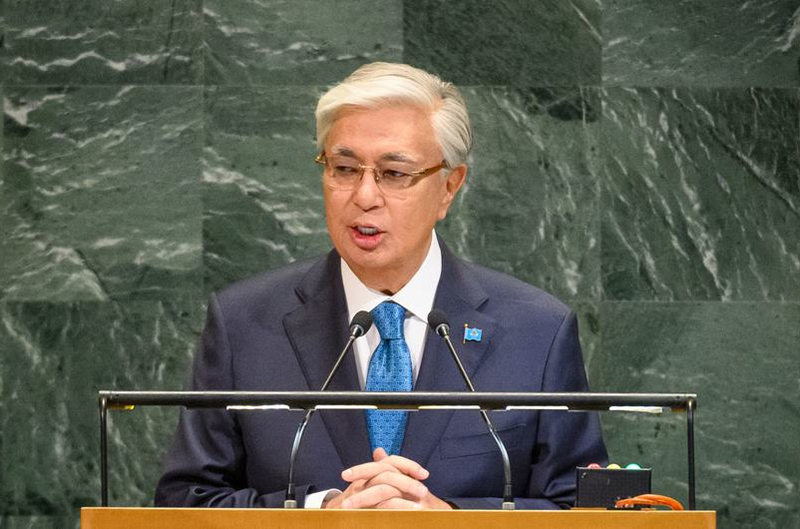
UN reform. The Head of State highlighted the crisis of trust in multilateral institutions and called for comprehensive reforms. Particular emphasis was placed on reforming the Security Council. He proposed the countries from Asia, Africa, and Latin America to be represented in the Council on a rotational basis. Additionally, the Head of State advocated for strengthening the role of Middle Powers as “they can act as bridges within the UN when major powers are divided or failing to resolve pressing issues of common concern.”
Disarmament and security. The President expressed concern over the erosion of arms control regimes and rise in global military spending, which has reached $2.7 trillion. He proposed resuming dialogue among nuclear powers and convening a new round of negotiations on disarmament and non proliferation. “Kazakhstan is ready to host a new dialogue on nuclear disarmament and non-proliferation,” he noted and recalled the country’s national initiative to establish an International Agency for Biological Safety.
Climate and environment. Addressing global warming, the President highlighted that the rate of temperature rise in Central Asia is twice the global average and glacier melt poses a serious threat to water and food security of millions of people. “Kazakhstan has drawn profound lessons from the tragedy of the Aral Sea. Thanks to our consistent efforts, including at the international level, we succeeded in preserving the northern part of the Sea,” he noted. Moreover, he emphasized the problem of the Caspian Sea’s shallowing, describing it as a global challenge that requires joint international action.
Transit potential. President Tokayev highlighted the region’s transit potential, noting that Kazakhstan is investing billions of dollars in the North–South and Belt and Road Initiative transport corridors. He emphasized that the development of infrastructure and logistics chains is positioning Central Asia as a key link in the emerging global transport network. “By 2029, Kazakhstan plans to build 5,000 km of new railway lines,” the President added.
Cooperation with the UN. Kazakhstan has reaffirmed its commitment to cooperation with the UN. The SDGs Center for Central Asia and Afghanistan is operating in Almaty. In April 2026, Astana will host a Regional Environmental Summit with the UN and international partners. Furthermore, 2026 has been declared the International Year of Volunteers for Sustainable Development at Kazakhstan’s initiative.
Statement by the President of the Kyrgyz Republic
“The Kyrgyz Republic has been advocating for the recognition of interconnectedness of natural systems, which are two poles of one system - “from mountains to oceans”
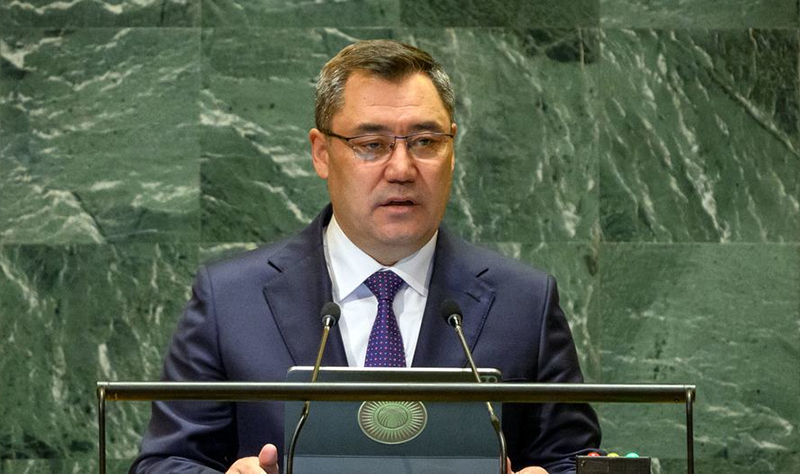
Unilateral sanctions. Mr. S.Zhaparov said that Kyrgyzstan is suffering from the consequences of the Russian-Ukrainian conflict and the accompanying unilateral sanctions. According to him, the restrictions against Kyrgyz banks are based on “false information” and hinder the development of the country’s young economy. “We cannot sacrifice the interests of our citizens and the economic development of the country,” he stressed, adding that Bishkek is ready to accept independent international audits in the financial sector. The President also pointed to the contradictions in the approaches of Western states: “You ask us not to cooperate with Russia, but you yourself are actively developing trade and economic ties with it.”.
Palestine and Afghanistan. Addressing global crises, the Kyrgyz leader called for an end to the “genocide of the Palestinians” in Gaza and supported the creation of two states – Israel and Palestine – within the borders of 1967. “Why are we allowing hundreds of thousands of civilians and innocent children, to be killed?”, he noted. Mr. S.Zhaparov paid special attention to Afghanistan, saying that the country’s frozen assets of more than $9 billion should be returned immediately: “If you want the Afghan people to get out of poverty and hunger as soon as possible, return their assets without delay.”
UN reform, regional cooperation and climate agenda. Addressing institutional reforms, the President of Kyrgyzstan highlighted the need to enhance the fairness and representativeness of the UNSC, underscoring the legitimate right of African states to broader participation. He also announced Kyrgyzstan’s candidacy for non permanent membership of the UNSC for the 2027–2028 term, noting that the country has never previously served in this capacity. The President further emphasized the importance of regional cooperation in Central Asia: “I can confidently say that today the borders between Kyrgyzstan, Tajikistan and Uzbekistan are the borders of friendship, trade and cooperation.”
A major part of the address focused on climate change. Kyrgyzstan, as a mountainous country, is particularly vulnerable to threats related to melting glaciers and dwindling water resources. He proposed using $3 trillion that are spent annually on weapons “to improve people’s lives and protect environment.” “We all breathe the same air,” he said, emphasizing the interconnectedness of natural systems “from mountains to oceans”. He also reminded of Kyrgyzstan’s plans to host in 2027 the Bishkek+25 Summit, which will center on sustainable future of highland areas.
Multilateralism. Concluding his statement, the President of Kyrgyzstan emphasized that the world needs joint actions and an updated system of multilateralism: “The future of our planet is our shared responsibility.”
Statement by the President of the Republic of Tajikistan
“We must not remain indifferent to the process of addressing the problems associated with the source of human life – water”
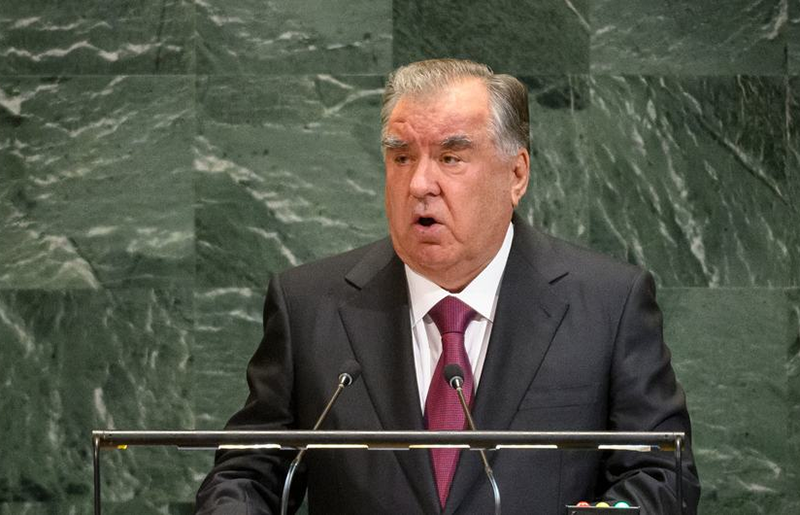
Support to vulnerable countries and reform of financial mechanisms. President E. Rakhmon pointed out the difficulties for developing, especially mountainous and landlocked, countries. He stressed that current financing tools don’t meet their needs. “Today is the time to think about writing off the debts of the most vulnerable states,” he said, stressing the need for fair reforms in the international financial system.
Climate challenges and glacier protection. The President placed significant emphasis on climate change, noting that mountains cover 93% of Tajikistan’s territory and over 1,300 glaciers have already vanished. “Tajikistan’s glaciers and other water sources account for up to 60% of Central Asia’s water resources. We must not remain indifferent to matter of addressing issues related to the source of human life – water,” he added. He also highlighted the International Conference on Glaciers’ Preservation hosted in Dushanbe in 2025 and invited international partners to take part in the next event under the Dushanbe Water Process scheduled for 2026.
Legal literacy and new technologies. The leader of Tajikistan proposed declaring the International Year of Legal Literacy, underscoring its role in fostering a global culture of justice. He also highlighted the increasing significance of digital technologies and AI, recalling that in July the UNGA unanimously adopted a resolution put forward by Tajikistan on the use of AI for sustainable development in Central Asia. In this context, he noted the potential utility of establishing a Regional Center for Artificial Intelligence in Dushanbe.
Combatting terrorism and cybercrime. The President called for enhanced international cooperation in the security area, highlighting the persistent threats posed by terrorism, extremism, and cybercrime. He reaffirmed Tajikistan’s commitment to further strengthening collaboration within the framework of the Dushanbe Counter-Terrorism Process. In conclusion, President Rakhmon emphasized that all disputes and conflicts should be resolved exclusively through political and diplomatic means, and urged the international community to intensify its efforts toward achieving sustainable and just peace.

Statement by the President of Turkmenistan
“A key area of cooperation between Turkmenistan and the United Nations is the promotion of international peace and security”
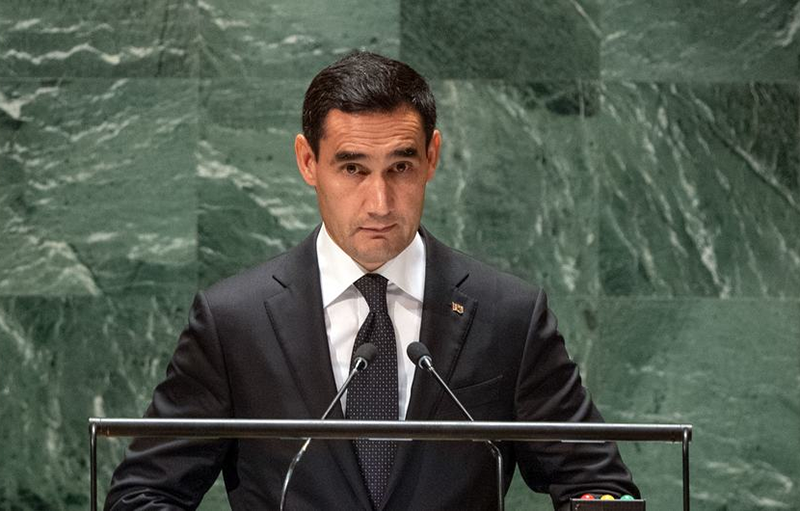
Peace and trust as strategic goals. Turkmenistan initiated the inclusion of a separate agenda item in the session entitled “Neutrality for peace and security”. According to President Berdimukhamedov, the policy of neutrality has proven its effectiveness as a practical mechanism for UN peacekeeping. He recalled that, at Ashgabat’s initiative, the current year has been declared the International Year of Peace and Trust, within the framework of which a high level international forum will be held in Turkmenistan in December. The President also proposed convening a World Summit on Culture of Peace and Trust, as well as developing a global code of international trust to serve as a universal framework for interstate relations.
Central Asia and cultural dialogue. Particular attention was paid to the Central Asian region, which “has served as a civilizational bridge between East and West for centuries”. In this context, he proposed to convene an International Forum “Central Asia – a Space of Peaceful Coexistence”, in partnership with the UN, involving regional countries, interested states, and international institutions. Another initiative involved a proposal to proclaim the International Day of Mediation to underscore importance of diplomacy and neutral platforms in the prevention and resolution of conflicts.
Sustainable development, transport and energy. Mr. S.Berdimukhamedov confirmed Turkmenistan’s commitment to the 2030 Agenda and proposed declaring the UN Decade of Sustainable Transport (2026–2035). “This step will consolidate global efforts to develop resilient and accessible transport corridors for all states,” he said. The country will also submit a draft resolution on the key role of stable energy connectivity for sustainable development and take the initiative to create a Global Platform for Digital Integration.
Climate and environment. The President of Turkmenistan announced his intention to establish a Regional Center to Combat Desertification for Central Asia. Other initiatives include hosting the 2026 Caspian Environmental Forum and advancing the Caspian Environmental Initiative, which was previously proposed by Ashgabat. In addition, Turkmenistan put forward a proposal to proclaim the International Day of Multilingual Diplomacy, emphasizing the role of cultural interaction in fostering international understanding and cooperation.
Cooperation with UN. Mr. S.Berdimukhamedov reaffirmed that cooperation with the UN constitutes a strategic priority for Turkmenistan, describing the Organization as “the only universal structure with universal legitimacy”. The President proposed to declare 2028 the Year of International Law to reinforce the legal underpinnings of international cooperation and peace.
Statement by the President of the Republic of Uzbekistan
“Today, across the world, the role and place of international institutions are weakening, confrontations, conflicts, and wars are intensifying, technological and social inequality is growing rapidly, and economic and humanitarian crises are deepening”
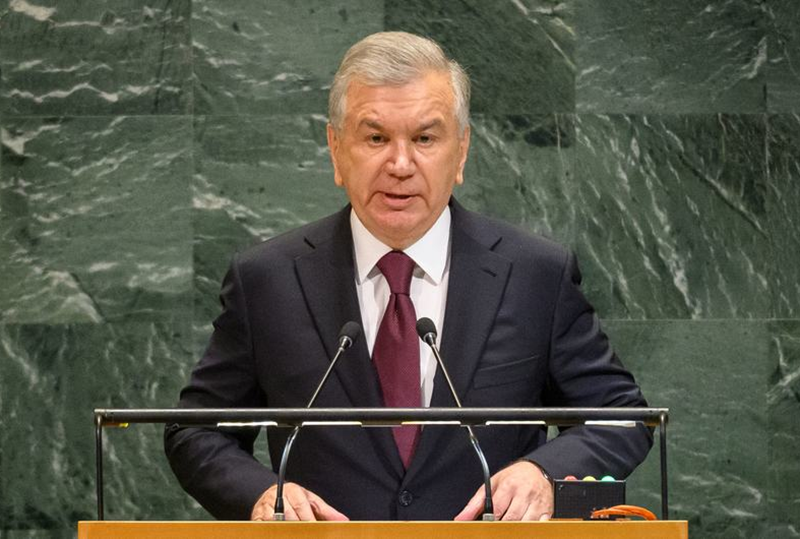
Reforms and social development in Uzbekistan. President Sh. Mirziyoyev spoke about large scale transformations underway in the country, emphasizing that “the highest priority is to fundamentally improve the lives of every family and every citizen, enhancing human dignity and well-being.” According to him, the poverty rate decreased from 35% to 6.6%, preschool enrollment rose from 27% to 78%, and the share of citizens with higher education increased from 9% to 42%. At the UN Headquarters, the President also put forward an initiative to host a World Summit on Professional Education in Uzbekistan and announced a high level event dedicated to combating childhood cancer.
Central Asia as a zone of partnership and integration. Particular attention was paid to regional integration. “The era of closed borders and unresolved disputes has become a thing of the past,” the President stated, noting a fivefold increase in mutual trade, investment, and transportation across Central Asia. In this context, a proposal was put forward to adopt a General Assembly resolution in support of regional integration processes, as well as to establish a number of new platforms under the UN auspices, including a Regional Hub of Green Technologies in Industry.
Afghanistan, Ukraine and the Middle East. The head of Uzbekistan stressed that “it is important not to isolate” Afghanistan and proposed adopting a resolution on the development of international transport and energy corridors through this country. He also called for an immediate cessation of hostilities in the Gaza Strip and expressed support for the principle of “two states for two peoples.” “The situation surrounding Ukraine also remains a matter of serious concern for all of us. We welcome the initiation of high-level dialogue aimed at resolving this issue through diplomatic means,” the President said.
Global challenges: climate, water and digital development. High priority was given to the issues of climate change and water security. Mr. Sh.Mirziyoyev recalled the consequences of the drying up of the Aral Sea and stated that by 2030 it is planned to green up to 80% of its dried up bed. The President also drew attention to the growing shortage of water and announced plans to host a World Water Conservation Forum, which is expected to develop a roadmap with innovative solutions. Other initiatives include the creation of an international mechanism for exchange of practical developments and AI models in the field of healthcare, education, and culture. “New Uzbekistan stands for solidarity, open dialogue, and close partnership with all countries,” Mr. Sh.Mirziyoyev affirmed, adding that the country is ready to contribute to strengthening dialogue among peoples and civilizations.
Selected Resolutions on Water, Climate and Sustainable Development Adopted by the UNGA 80th Session
Awaza Political Declaration ((A/RES/80/3); Implementation of the Convention on Biological Diversity and its contribution to sustainable development ((A/RES/80/140); Implementation of the United Nations Convention to Combat Desertification in those countries experiencing serious drought and/or desertification, particularly in Africa ((A/RES/80/139); Protection of global climate for present and future generations of humankind ((A/RES/80/138); Disaster risk reduction ((A/RES/80/137); Agricultural technology for sustainable development ((A/RES/80/133); International cooperation on humanitarian assistance in the field of natural disasters, from relief to development ((A/RES/80/113); Oceans and the law of the sea ((A/RES/80/110); 2028 United Nations Conference to Support the Implementation of Sustainable Development Goal 14: Conserve and sustainably use the oceans, seas and marine resources for sustainable development ((A/RES/80/108); Agriculture development, food security and nutrition ((A/RES/80/157); Sustainable mountain development ((A/RES/80/144); Combating sand and dust storms ((A/RES/80/143).
Development and support
Scientific-Information Center ICWC