
| News | Events | Sites | Database | Knowledge Base | Forum |
|
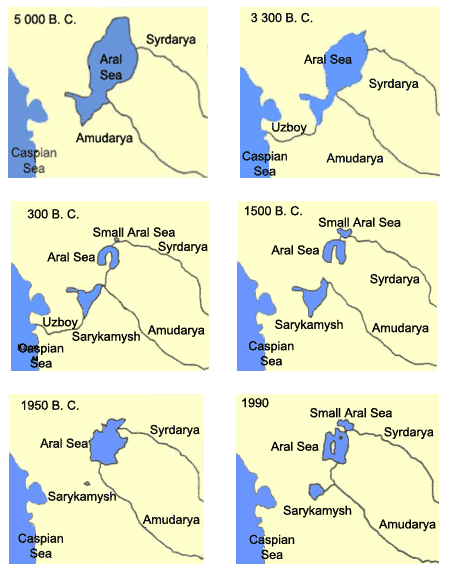
THE ARAL SEA AND SOUTH PREARALIE (2) Based on geological and historical investigations, most researchers (B.V. Andrianov, À.S.Kes, P.V. Fedorov, V.A. Fedorovich, Y.G. Maev, I.V. Rubanov, A.L. Yanshin and others) have came to the almost unanimous conclusion, which was well formulated by N.V. Aladin: “in prehistoric times, changes in the Aral Sea level and salinity took place due to natural climatic changes”. During the humid climatic phase the Syr Darya and Amu Darya rivers were abounding in water, and the lake reached the maximum level of 72 to 73 m +BSL. In contrast to that, in arid climatic phases both rivers became containing little water, the Aral Sea level also dropped, and the salinity level increased. In historical times, during the existence of the ancient Khorezm, the changes in the water level depended to some extent on climate change, but mainly on irrigation activity in the basins of two rivers. In the periods of intensive development of the countries adjacent to the Aral Sea, the increase in irrigated areas resulted in withdrawal of most of water for this purpose, and the sea level had immediately dropped. Unfavorable periods (wars, revolutions, etc.) in the region were followed by reduction of irrigated lands, and the rivers filled up again. Geological and hydrological surveys, carried out by À.P. Kes and a number of the prominent geographers in the 1980s, showed that the Amu Darya and Syr Darya rivers changing regularly their flow direction and migrating throughout Central Asian in the historic period have not often reached the Aral Sea, and as a result the sea has dried up and a desert zone has formed on its territory. At the same time, as the sea was drying up, water salinity was considerably increasing and promoting precipitation of salts, which were found by the geologists at the bottom of the Aral Sea. Thick layers of mirabilite precipitations are especially impressive. The migration of both the Amu Darya and Syr Darya deltas has established a very peculiar downstream area, where the depressions filled with boggy deposits alternating with deserted, fine-silty, and sandy deposits that formed the delta and the most part of the Amu Darya River bed itself and its branches. On the other hand, the field studies carried out by zoologists, in particular, by Polishchuk and Aladin from the Zoological Institute under the Academy of Sciences of USSR in 1990 have shown that the Aral Sea itself is characterized by very poor original fauna and the absence of many species that are in the Caspian Sea which is similar according to its origin. At the same time, endemic species were found in the Aral Sea indicating that salinization of the Aral Sea, which took place from time to time affected these large-scale transformations. The analysis carried out by zoologists has shown that a small number of marine and oceanic species remained in the Aral Sea; however communities of brackish water species including the Caspian-estuary fauna have been destroyed here. All the rivers emptying into the Aral Sea have not retained marine fish species or, at least, remains of this fauna. It means that water of the Amu Darya and other rivers, in one way or another, has penetrated both into the Aral Sea depression and through the Uzboy valley into the Caspian Sea. At the same time, it is necessary to note very developed deltas of the Syr Darya and Amu Darya rivers, which occupy sufficiently large areas. According to data of N.M. Novikova, during the period of sustainable water inflow (approximately 41 cu km/year), the total area of flooded lands exceeded 3,800 sq km, the area of lakes amounted to 820 sq km, only in the Amu Darya delta. The delta of the Syr Darya was also significantly developed. At the same time, a highly intensive vegetative background was widely spread in the delta. The periodically flooded delta was characterized by large areas of fructiferous reeds, tugai, hayfields and pastures. In particular, till 1970 only in the Amu Darya delta the area of reed thickets amounted to 700,000 ha, tugai – 1,300.000 ha, hayfields – 420,000 ha, and pastures – 728,000 ha. Appropriate areas in the Syr Darya delta were also occupied by deltaic and other vegetation. À.S. Kes has her somewhat different opinion. Agreeing with opinions regarding several periods of the Aral depression flooding starting from the late Pliocene, at first by waters of the Akchagyl Sea and later the Apsheron Sea, she does consider that the existence of the united Aral-Caspian Sea has not been proved and insists on the absence of a link between the Aral and Caspian seas, though she supports the opinion that the highest elevation of the early-Apsheron lake were 80 m +BSL reducing to zero at the tail part of the Apsheron sea. The Akchagyl period was marked, in her opinion, by the partial existence of the Aral Sea with water level lower than the modern one (about 40 m + BSL). In the late Stone Age, the Amu Darya River, having filled up the Khorezm depression with alluvium, has burst into the Sarykamysh depression and formed the big Audan Lake here and in the Assaka depression; about 20 percent of water of this lake (it was restricted by hydraulic parameters of the Uzboy channel) have released through the Uzboy channel into the Caspian Sea. This inflow continued during the 4th and 3rd millennium B.C., periodically occurred in the 2nd and early 1st millennium B.C. At that time, the Syr Darya River flowed into the Aral Sea. Though À.L. Yanshin tried to prove the presence of transgression in this period, the subsequent studies by L.G. Kiryukhin, Kravchuk and P.V. Fedorova (1966) as well as the most recent studies carried out by I.V. Rubanov (1982), Y.G. Mayev, Y.À. Kornichev (1999) have refuted his arguments. At present, it is clear to a certain extent that (according to the recent radiocarbon measurements of bottom sediments) the Aral Sea has undergone five or seven transgressions, out of which the strongest ones formed the highest terraces (elevations of 72 to 73 m + BSL), pertaining obviously to the early Pliocene (À.V. Shitikov) or to the Akchagyl period. The source of such high flooding is not clear. This might be either consequences of melting of northern ice masses, as V.À. Kovda and V.V. Yegorov have supposed in their work “Behavior of salt accumulation in the Aral-Caspian lowland” (the Academy of Sciences of the USSR, 1956), or water inflow of the Great Amu Darya, which was mentioned in the Avesta (supposedly, this river has united not only waters of all the Great Amu Darya tributaries including the Zeravshan, Tedjen, Murghab but also the Syr Darya and Chu till damming the Buam isthmus). In this context, the results of revising the investigations of P.I. Chalov and others (1966) carried out by À.S. Kes are of interest. The first stage of the Aral depression flooding began in the late Pliocene. At that time, western plains in Central Asia were flooded at first by water of the large Akchagyl Sea, and then by the Apsheron Sea. Their eastern border was not determined, but fauna, terraces and beach ridges dated by this age are found in the Sarykamysh and Assaka-Audan, Aral Sea depressions, and in some depressions of the Kyzylkum desert. The modern period of the Aral depression flooding began in the 1st millennium B.C., when the Amu Darya having formed the pre-Sarykamysh and Akchadarya deltas moved towards the Aral depression and together with the Syr Darya, which flowed through the Janadarya and Kuvandarya channels, started filling it up and formed the modern sea. At the beginning of the XIX century the Aral Sea level was low. In 1845 and after the 1860s some increases in the level were observed. At the early 1880s the level became unusually low; the researchers of that time came to the conclusion that progressive reduction of water resources in Central Asia was taking place. However, in the 1880s the Aral Sea level began rising, at first rather slowly, then more quickly. That continued till 1906. The level stopped changing in 1907, and then it increased again in 1908 and lowered in 1909. The rise was registered once again in the period since 1910 till 1912, and then the level slowly changed till 1917. The decrease began after the year 1917, which is known by the high level of aridity in Central Asia. By 1921 the level of the sea had reduced by 1.3 m in comparing with 1915. However, the observations in 1924 showed new increase (a little less than by 0.5 m). The range of fluctuations during the period since the end of the 19th century till the beginning of the XX century was about 3 m. Natural water resources of the Amu Darya River (without inland basins of the Tedjen, Murghab and other rivers) amount to 75 cu km per year in the runoff formation zone, and those of the Syr Darya River – 37 km3 per year (in total - 112 km3 a year). The fluctuations in availability of annual Amu Darya and Syr Darya water resources are significant enough (coefficients of variation Ñv for the both rivers are 0.15 and 0.21 accordingly) and are characterized by high synchronism (a correlation coefficient is 0.83) that makes difficult water supply of the main water users in dry years. The Amu Darya and Syr Darya basins are regions of an ancient irrigation that affected natural flow of these rivers during a long time. Prior to the early 1950s volumes of irreversible water withdrawals fluctuated insignificantly both in each of the river basins and over the entire Aral Sea basin, and amounted to 29 to 33 km3 per year. The increase in water withdrawal from the rivers in the 1950s to 35 to 42 km3 per year, caused by extension of irrigated lands area and water-related activities (construction of reservoirs on the Syr Darya River, water diversion from the Amu Darya into the Karakum Canal), was compensated by some reduction in streamflow losses, and also by natural high humidity in this decade (total water resources exceeded the norm by approximately 9 percent). As a result, inflow into the sea and its regime were kept relatively stable till the early 1960s.
The period since the beginning of systematic instrumental measurements of the water level and other regime characteristics of this water body (1911) till the 1960s may be defined as conditionally natural. An approximate equality of inflow and outflow components of the water balance of the sea (Table) determined little fluctuations in the sea level approximately at the elevation of 53 m + BSL, which was assumed as the mean annual level. The average water surface area at the elevation of 53 m + BSL amounted to 66,100 km2, and the water volume reached 1,064 km3.
Table. Mean annual water balance values of the Aral Sea for different periods
According to its dimensions, the Aral Sea was ranked as the fourth lake all over the world after the Caspian, the Great Lakes in North America and Lake Chad. The area of the Aral Sea constituted 64,490 km2 (with islands); a maximum length - 428 km, a maximum width - 284 km. The lake was relatively shallow: a maximum depth was 68 m, and an average depth was only 16 m. The deepest places were located along the western shore in the form of a narrow strip; the area of parts of the sea deeper than 30 m amounted to only about 4 percent of the entire area of the lake. Thus, the ancient Aral Sea that had undergone 5 or 6 transgressions - increases and consecutive desiccations - has once again come up to the threshold of a new shrinkage.
|
|||||||||||||||||||||||||||||||||||||||||||||||||||||||||||||||||||||||||||||||||||||||||||||||||